

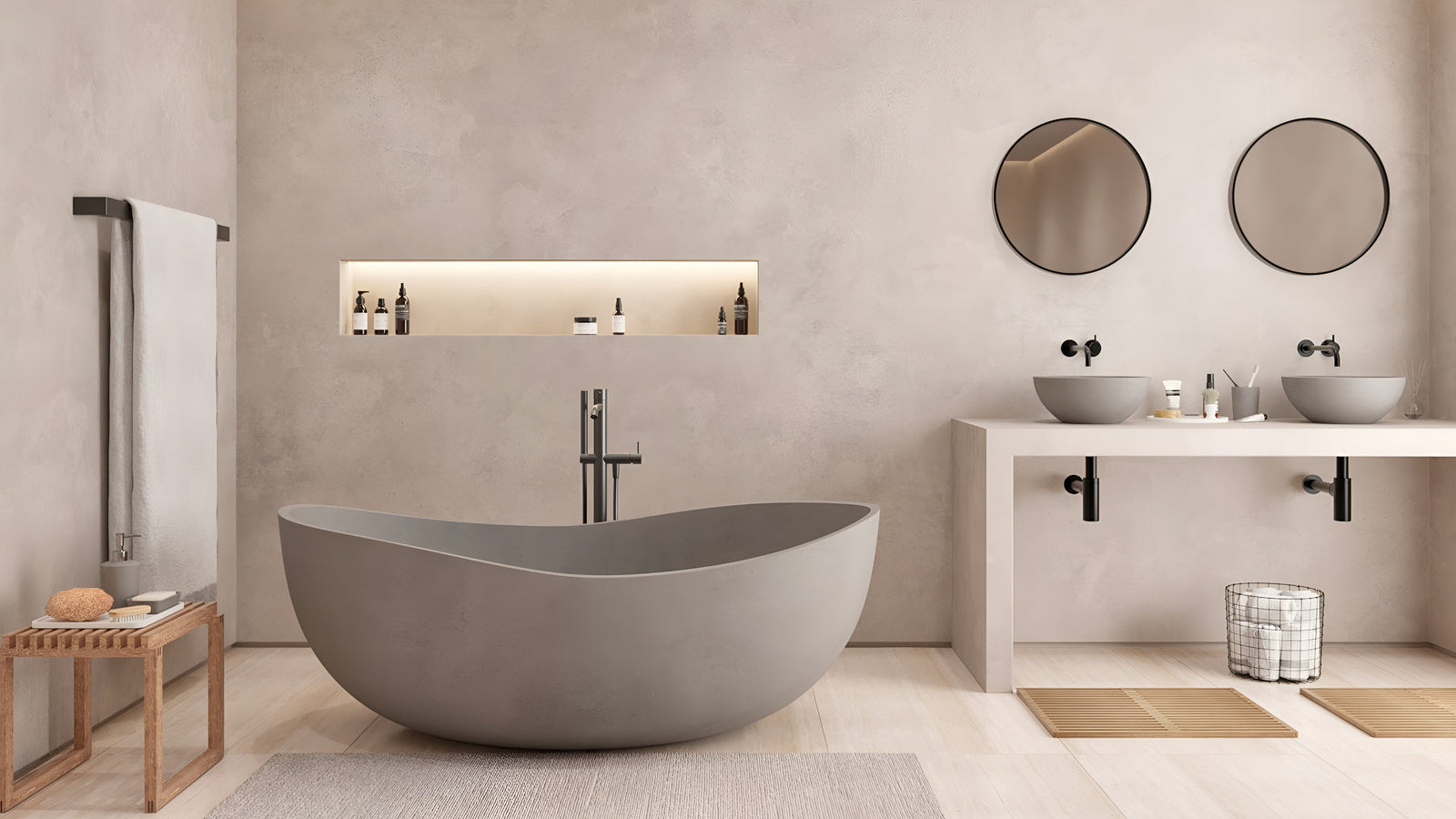







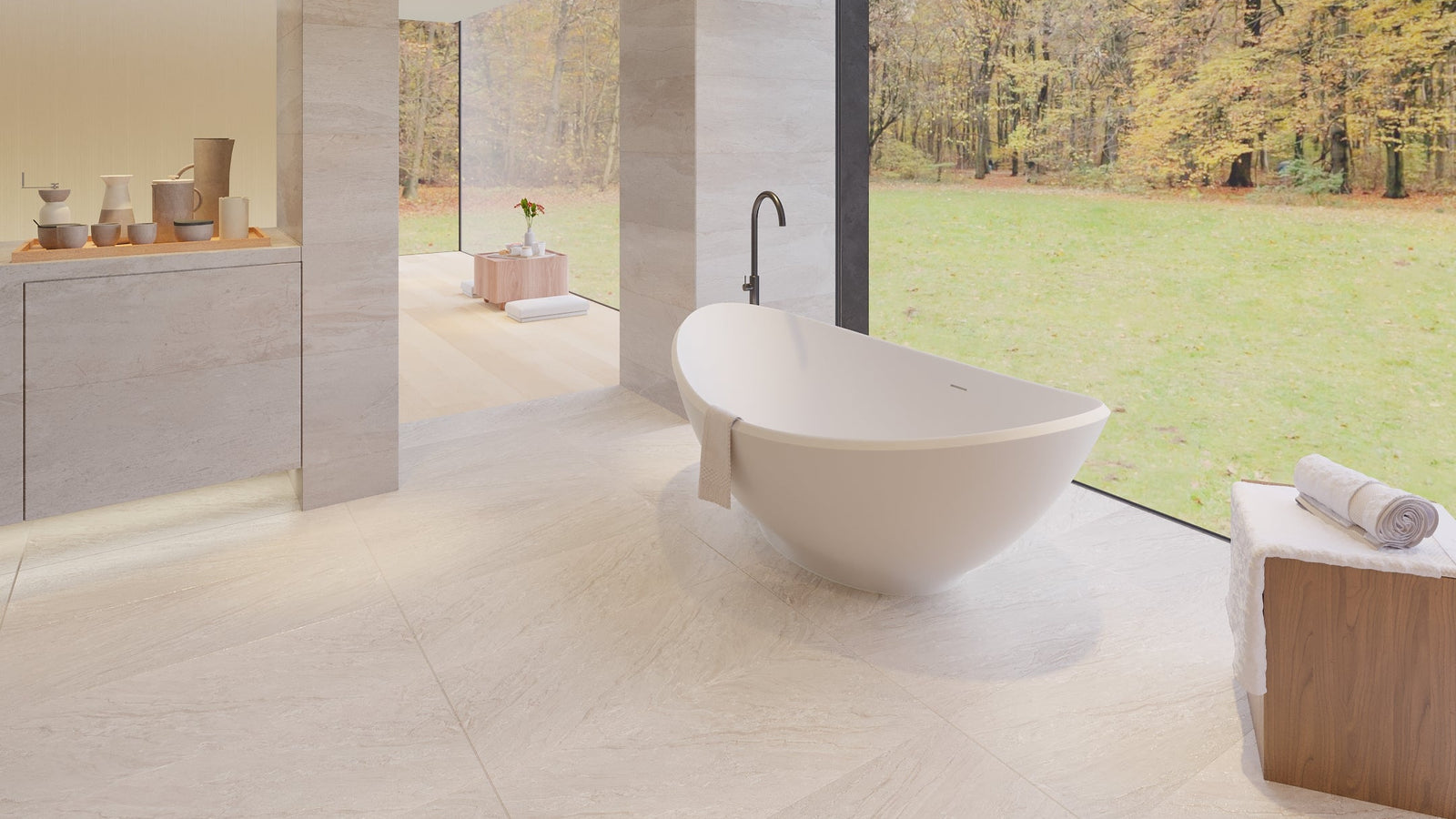



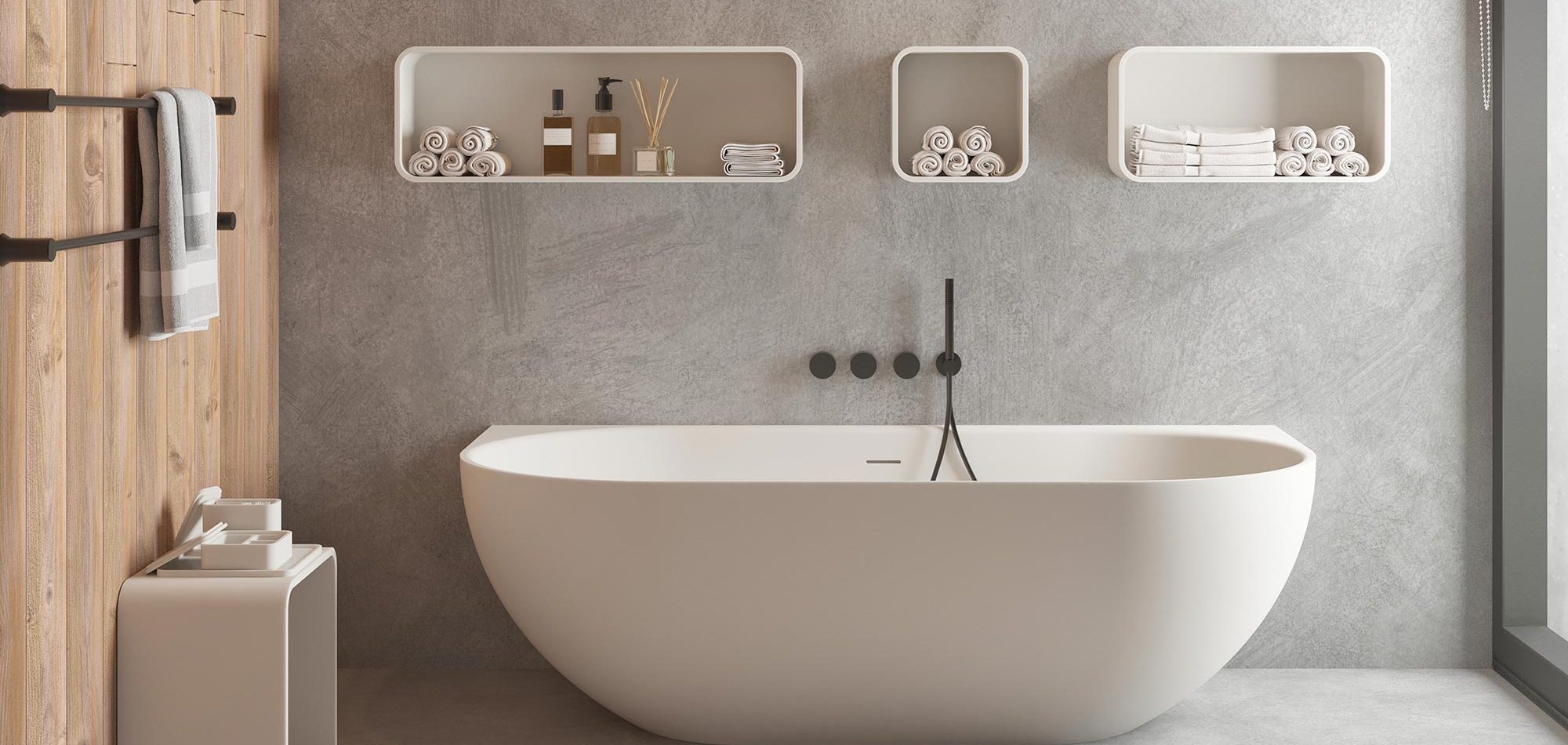
Soaking freestanding bathtubs change the geometry of a bathroom. A freestanding tub can stand in an open area or sit against a wall, but its visible exterior makes it feel more like a piece of furniture than a built-in fixture, with the material becoming part of the design story. Solid surface, concrete, and stone each bring a different presence to that shape. They also ask different things of a buyer, from the way the surface feels on your shoulders to the questions you should put to a supplier before you commit.
This article looks at those three materials, explains why "soaking" and "freestanding" describe two separate ideas, and sets out the practical checks that belong in any order for a tub of this kind.
Soaking and Freestanding Describe Two Different Things
The two words get used interchangeably, but they answer different questions. As one industry explainer puts it, "soaking" describes how a bathtub is meant to be used, while "freestanding" describes how the bathtub is installed. A tub can be one, the other, or both.
On the soaking side, depth is the defining trait. Soaking tubs are designed for long, unhurried soaks, which is why they are built deeper than a standard bathtub, with one source noting that a soaking tub will hold at least 14 inches of water. The goal is immersion: deep freestanding soaking tubs are designed so the water covers more of the body, which is what turns a quick wash into a proper soak.
On the freestanding side, the definition is structural. Freestanding tubs are basically bathtubs that are not attached to a wall. That single fact drives everything else about how they are specified, installed, and placed in a room. Because nothing is holding the tub in position, the tub has to hold itself, and the floor beneath it has to be checked with that in mind.
Most of the tubs discussed in this article are both at once: deep enough for a real soak, and unattached so the silhouette stays visible from more than one angle. That combination is why the material choice matters so much. A freestanding tub is exposed on all sides, so there is nowhere for a lesser surface to hide.
Solid Surface Freestanding Tubs
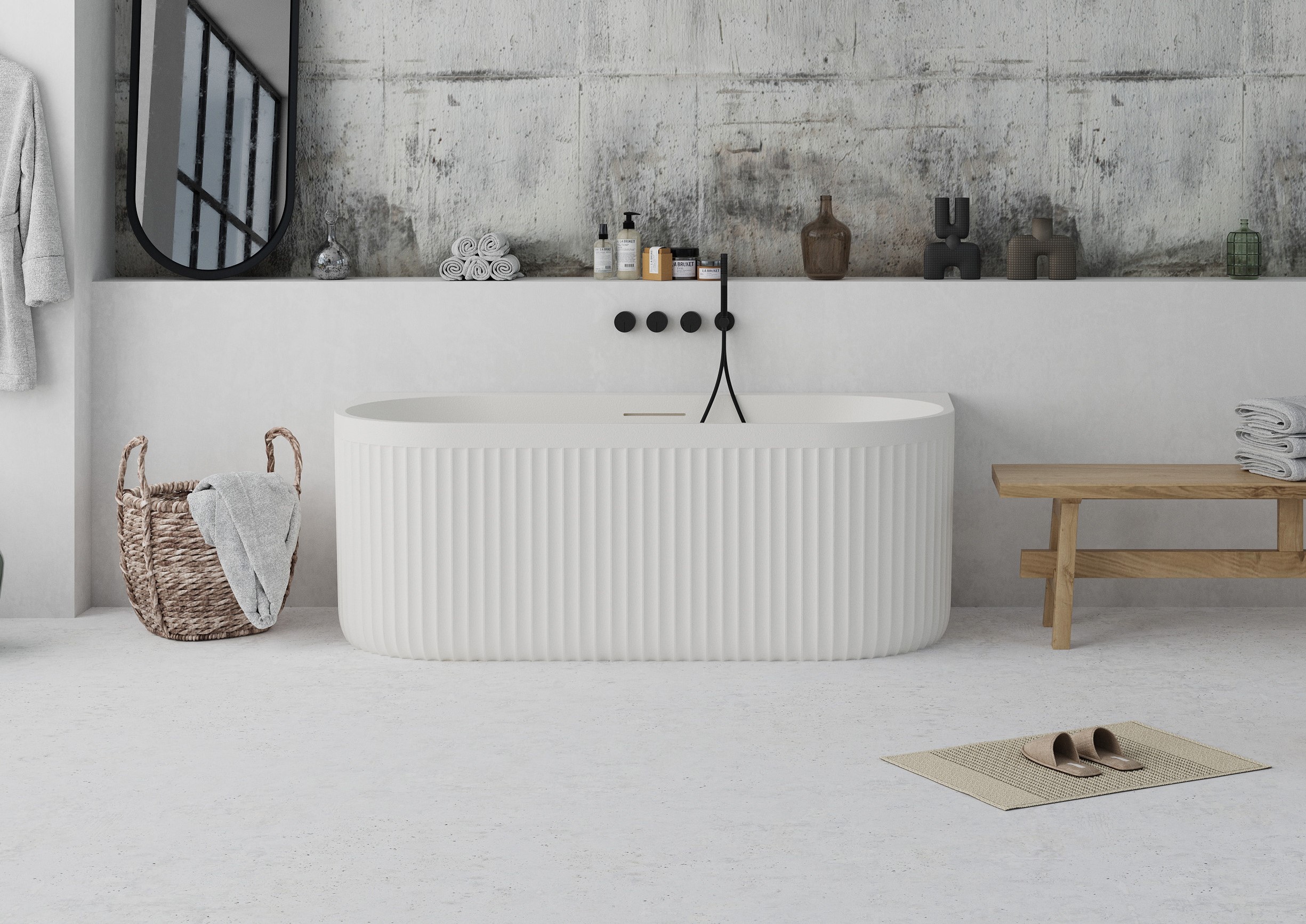
Solid surface gives a designer the shapes that are hardest to achieve in quarried material. With smooth silhouettes, refined proportions, and deep soaking comfort, tubs in this family are made to let the bathroom feel more open, elegant, and spa-like. The forms tend to be continuous, with soft transitions rather than visible seams, and that continuity is a large part of the appeal when the tub is standing in the middle of an open floor plan.
Where solid surface earns its place
This is the material to consider when the design idea comes first and the shape has to follow it. A sculpted rim, a softened corner, a profile that narrows toward the base: these are easier to produce in a manufactured material than in a block of stone, and the result is a tub that looks drawn rather than carved.
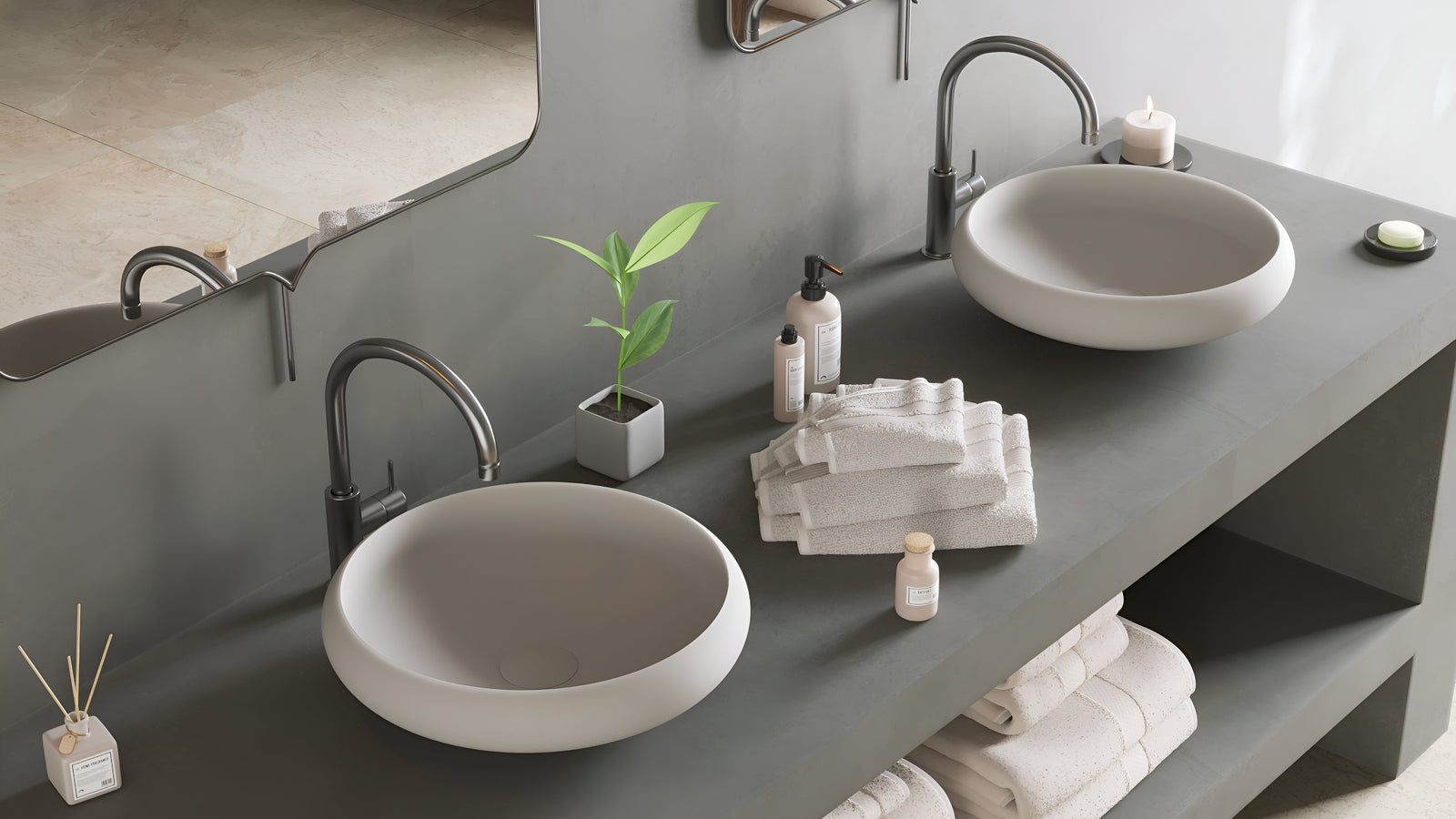
Solid surface also suits bathrooms where several elements need to relate to one another. If the tub has to echo the lines of a vanity or a washbasin, a manufactured material gives more room to match profiles and finishes. Buyers comparing it with acrylic should note that acrylic freestanding tubs are valued for being lightweight and durable while retaining heat, which is a different set of priorities. A solid surface tub is chosen for appearance and form, and the finish and care guidance should come from the manufacturer in writing.
Concrete Freestanding Tubs
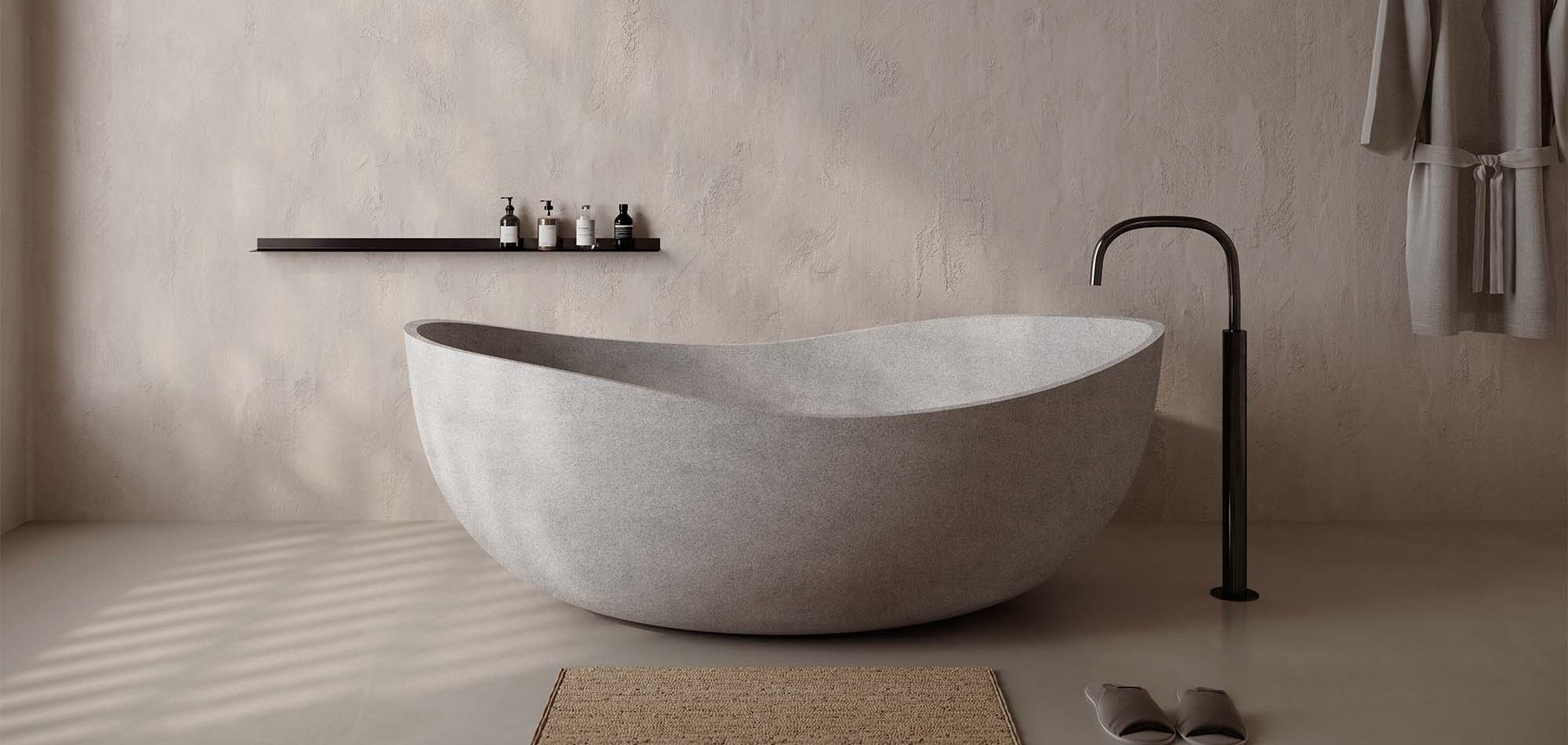
Concrete delivers a different kind of calm. Where solid surface reads as smooth and sculpted, concrete reads as cast and grounded, with a matte mineral surface and a sense of visual mass that anchors a large bathroom. In a room with a lot of glass, pale tile, and daylight, that weight is useful. It keeps the tub from disappearing.
Concrete is also a casting material, which means the tub can be formed as a single continuous body with a rounded interior and a rim that feels substantial under the hand. That thickness is part of the experience of bathing in it: the rim is wide enough to rest an arm on, and the whole object feels deliberate.
What to confirm before ordering
Concrete is heavy, and a freestanding tub puts its weight on a small footprint in the middle of a floor rather than spreading it along a wall. Before ordering, confirm three things with the supplier: the finished weight of the tub, the floor loading guidance they provide, and the sealing and care routine for the specific finish you are buying. Then have a contractor confirm that the floor assembly can carry it. None of that is guesswork a buyer should do alone, and reputable suppliers will provide the documentation.
Also ask how the interior surface is finished. Concrete tubs vary in how the bathing surface is treated, and the answer determines which cleaners are safe and how often the surface needs attention. Get that in writing rather than relying on a generic web answer.
Stone Freestanding Bathtubs
Stone is the material that guarantees the tub will not look like the one next door. It is quarried rather than manufactured, so variation in tone and veining is part of the product rather than a defect. In a bathroom built around natural textures, a stone soaking tub can be the element that makes the rest of the scheme feel intentional.
Stone also has a physical character that bathers notice. It is dense and cool to the touch, and it holds the temperature of the room rather than quickly matching the water. Some people love that quality in a bath and treat it as part of the ritual. Others prefer a surface that warms up fast, which is where solid surface and acrylic have an advantage. There is no wrong answer, but it is worth deciding which experience you actually want before you fall for a photograph.
Buying stone with your eyes open
Because stone is a natural material, ask to see the actual slab or the actual finished piece you will receive, not only a representative image. Confirm the finish, the sealer that will be applied, and the maintenance routine the maker recommends. Confirm the weight, and have the floor checked the same way you would for concrete. Stone is a specification purchase, and the paperwork matters as much as the shape.
Comparing the Three Materials
The table below summarizes how each material tends to behave in a freestanding soaking tub. Treat it as a starting point for a conversation with a supplier, not a substitute for their written specifications.
Material |
Character in the room |
What to plan around |
|---|---|---|
Solid surface |
Smooth, continuous silhouettes with refined proportions and deep soaking comfort; helps a bathroom feel open and spa-like |
Confirm the finish, the recommended cleaners, and the care routine in writing |
Concrete |
Cast, matte, and substantial, with a rim that feels solid under the hand |
Confirm finished weight, floor loading guidance, sealer, and interior surface treatment |
Stone |
Natural variation in tone and veining, dense and cool to the touch, each piece distinct |
Review the actual slab or finished piece, the sealer, the care routine, and the weight |
Choosing by Room, Not Just by Material
Material is only half the decision. Soaking tubs offer deeper immersion for full-body relaxation, while more compact freestanding tubs suit smaller bathrooms, and that trade-off usually decides more than any finish sample. A deep tub in a room that cannot comfortably spare the floor space becomes an obstacle. A shallow tub in a generous room may leave the bather wishing for more water.
Start with the footprint. Freestanding tubs are not attached to a wall, so they need clearance on more than one side for walking around, for reaching the faucet, and for cleaning. Then measure the route into the bathroom, including doorways and turns, because a large tub has to physically arrive in the room. Finally, look at the rim height against the people who will use it most. A deeper soaking tub is a pleasure to sit in and a slightly taller step to enter.
What to Confirm Before You Order
Whatever material you choose, a freestanding soaking tub is a specification purchase, and the details are where projects go wrong. Work through these points with your supplier and your contractor before the order is placed.
The exact exterior dimensions and the interior soaking depth, so you know both the floor space required and how deep the water will sit.
The finished weight of the tub and the floor loading guidance the maker provides.
The care routine, recommended cleaners, and any sealing or resealing schedule for the specific finish.
The faucet and filler requirements for a freestanding installation, since there is no wall to mount a spout on.
Delivery access, including doorway widths and any stairs on the route.
Get those answers in writing. A supplier who sells this category regularly should have them ready, and a contractor who has installed freestanding tubs before will know which of them affect the schedule. The material you fall for in a photograph is only the beginning of a decision that should end with a documented, buildable specification.
Frequently Asked Questions
Are soaking tubs and freestanding tubs the same thing?
No. Soaking describes how a tub is meant to be used, while freestanding describes how it is installed. A tub can be one, the other, or both. Soaking tubs are built deeper than standard tubs so you can submerge more of your body, and freestanding tubs are simply not attached to a wall. Many models sold today are both at once.
Do stone and concrete tubs need special care?
Ask the maker before you buy. Stone and concrete are dense, mineral-based materials, and the care routine depends on how the surface was finished and whether a sealer was applied. Request the written care instructions, the recommended cleaners, and any resealing guidance, then follow that document rather than a generic routine found online.
How much space does a freestanding soaking tub need?
Plan for the tub itself plus clearance to walk around it and reach the faucet. Because freestanding tubs are not attached to a wall, they need breathing space on more than one side. Measure the doorway and the turn into the bathroom as well, since the tub has to reach the room before it can be installed.
Is a deeper soaking tub harder to get in and out of?
It can be, and that is worth testing in person where possible. Soaking models are built deeper than standard tubs, with one source noting a soaking tub will hold at least 14 inches of water, so the step over the rim is taller. A freestanding design set away from the wall does allow entry from more than one side.